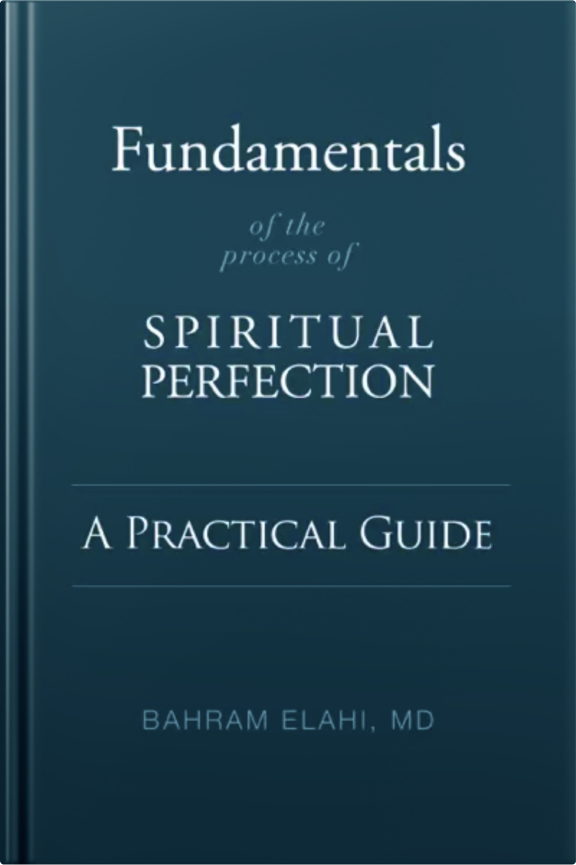
The purpose of this site is to analyze and explore in greater detail the latest book by Bahram Elahi, MD, entitled “Fundamentals of the Process of Spiritual Perfection: A Practical Guide” (New York: Monkfish Book Publishing Company, 2022).
The author’s stated objective in writing this Practical Guide is to answer the perennial questions of humankind and to set forth the process of spiritual perfection that leads human beings to their ultimate goal. According to the author, the most effective way to utilize this guide is to study it as one would a handbook. Similarly, he recommends that readers carefully study the eight figures that depict the human soul at the outset of the book before reading this Practical Guide.
The site therefore features a variety of tools that allow for a closer, in-depth examination of the book and its accompanying figures:
- Videos: A series of animated, three-dimensional videos with narration for each of the figures
- Key Concepts: A menu of key concepts compiled and summarized in Question and Answer format.
- Interactive Figures: A scalable model of the human soul identifying its components and faculties
- Daily Quiz: A daily question from the book to gauge your understanding
- Self-Assessment: A series of five questions on the different figures in the book
The fundamental stage essentially consists in examining and mending one’s faith (directing it toward a true God), sufficiently developing one’s sound reason, and cultivating one’s humanity.
To complete the fundamental stage, we have a duty (obligation) to sincerely and diligently seek and find Divine guidance, which is always present on earth. By connecting our thought to this guidance, we will come to know what goal to adopt in spirituality and which direction to take, what we must do and how we must do it, and what actions we must avoid.
The divine flux is a continuous current of consciousness—Divine consciousness—that originates in the radiance of the One. Imbued with His thought, power, and will, this flux envelops all beings and penetrates all things.
By means of the divine flux, He perpetually and simultaneously maintains a direct and conscious relationship with every being—from the most minute to the most immense—in the material and spiritual realms, while every being in these realms simultaneously has a direct relationship with Him, whether it is conscious of it or not.
Divine light, living real divine truths, and spiritual provisions constitute the principal nutrients of the soul that foster its development, i.e., the development of its sound reason.
To develop our sound reason, we must begin by practicing, in a diligent and in vivo manner, correct divine and ethical principles (which are included among living real divine truths). As our sound reason develops, our faith (primary divine love) evolves and transforms into a rational love of Truth, a love that stems from our sound reason.
All that remains for beings endowed with reason and free will (including human beings) is to engage in the essential duty of undertaking their process of spiritual perfection. Those who are able to fulfill this essential duty and engage in their process of spiritual perfection—by means of their own willpower and effort, and with steadfast support from the metacausal energy of the One—until their knowledge of Truth is complete will reach the threshold of Perfection. But crossing this threshold and reaching Perfection are solely dependent upon His will.
Key Concepts
Given our reason and free will, how long do we remain responsible for our destiny?
By virtue of our reason and free will, until such time as we have reached Perfection, we ourselves are responsible for our own destiny, be it material or spiritual. (Chap. 17, p. 235)
As a result of our reason and free will, what responsibilities and obligations do we bear?
- [H]umans, by virtue of their reason and free will, must learn the duties that correspond to their potential creational rights and the correct way to carry them out if they wish to practically benefit from them. (Chap. 1, p. 30-40)
- By virtue of our reason and free will, we have but one essential spiritual duty while living in this world: to diligently engage in our process of spiritual perfection in order to complete its fundamental stage here on earth. (Chap. 10, p. 127-28)
- [B]y virtue of our reason and free will, we will have to answer for our thoughts, words, and actions during our stay on earth, which were contemporaneously recorded in our soul. (Chap. 10, p. 129)
What consequences will ensue if we do not accept that our own free will plays a role in determining our destiny?
If we do not bring ourselves to accept that our own free will plays a determining role in our destiny (material and spiritual alike) until we reach the threshold of Perfection, our outlook on life and the spiritual laws that govern it will be erroneous and will draw us into a vicious cycle of endless protests and objections against God—assuming we have faith in Him—or the ways of the world. (Chap. 12, p. 166)
To what extent do we have free will?
[H]uman beings must make their own choices within the limits of their reason and free will; in situations that exceed the limits of their free will, it is God who decides. (Chap. 18, p. 243)
What is the difference between faith and the rational love of Truth?
The difference between primary divine love (faith) and the rational love of Truth is that the former is only a sentiment or intuition, an emotion that is engendered by the impulse to worship and thus prone to error. By contrast, insofar as the rational love of Truth stems from our sound reason, it is also accompanied by the ability to discern Truth and living real divine truths. (Chap. 2, p. 57)
What are the stages in the evolution of faith?
There are various stages in the evolution of faith: Faith in the right source (faith in a true God), faith that is sincere, faith that is whole (complete), and the rational love of Truth. (Chap. 2, p. 55)
What is the impact of having faith in the right source?
Faith, when it is right (correct faith) and sufficiently developed, soothes the heart and engenders optimism and hope in the future. (Chap. 2, p. 55)
What are the benefits of a sincere faith?
Sincere faith in the One (or in a true God, such as the God of an authentic monotheistic religion) positively impacts our spiritual membrane, allowing for the influx of energy from positive souls or entities into our spiritual unconscious, while blocking the influx of energy from negative souls or entities. The more sincere our faith in a true God, the more effectively this membrane resists the infiltration of energy from negative entities.
(Chap. 9, p. 112-13)As long as our faith in a true God remains sincere, our spiritual immune system will function properly and these saprophytic negative entities will remain harmless; otherwise, these very entities will become pathogenic for our soul.
(Chap. 12, p. 161)The more sincere our faith in the One or in the true God of our faith, the more we will attract His gaze and the more we will come to merit His intervention in our lives and our spiritual destiny.
(Chap. 12, p. 166)Sincere faith in a true God is essential because it provides the metacausal energy that is required for the struggle against one’s imperious self and the formation of divine virtues.
(Chap. 13, p. 180)
How can we examine and mend our faith?
We can examine and mend our faith by exercising as much diligence as necessary to ensure that we are placing our faith in a true God—for example, the God of one of the authentic monotheistic religions, such as the God of Abraham, the God of Zoroaster, the entity that illuminated the historical Buddha, the God of Moses, the God of Christ, the God of Muhammad—or directly in the One Himself (the original God) or in the Point of Unicity. (Chap. 20, p. 254)
Why does the practice of ethics require the support of faith?
Without the backbone of faith, the practice of ethics is encumbered. [W]ithout faith, morality alone often falls short in the face of the strong temptations of the imperious self. (Chap. 9, p. 112; see also chap. 15, p. 214)
What is the role of faith in transforming a character weak point into a divine virtue?
Only a sincere faith in the One, or in the God of one’s religion (provided He is true), brings about the metacausal energy necessary to transmute a character weak point into a divine virtue. (Chap. 14, p. 200)
What is the meaning of “attention” and “dialogue”?
‘Attention’ consists in mentally delving within (the bubble of our soul) and focusing on the One, either directly or indirectly through the channel of the God of our faith (provided He is true), or through the channel of an Essence-bearing Presence. ‘Dialogue’ consists in speaking intimately to the One (the Source of Truth)—by way of the divine flux—in the language of our inner guide. (Chap. 12, p. 150, 156)
What are three benefits of practicing the exercise of attention-dialogue?
- Practicing the exercise of attention-dialogue daily for a few minutes or more each day is effective in developing constant attention within us. (Chap. 13, p. 175)
- Having sincere faith, socializing with positive individuals, and devoting a few minutes or more each day to the exercise of attention-dialogue are helpful in developing a defensive reflex that automatically devalues and rejects negative thoughts upon encountering them. (Chap. 9, p. 112)
- Fuel [in the vehicle analogy] symbolizes the energy-producing metacausal substance that is acquired through the in vivo practice of living real divine truths and the daily exercise of attention-dialogue. (Chap. 17, p. 232)
What are the conditions for the exercise of attention-dialogue?
- That we sincerely (wholeheartedly) seek the Truth, even if our sincerity is reasoned and based on self-persuasion.
- That the Presence we choose (a God, prophet, or saint) and designate as our focal point to engage in a dialogue with the One be true, meaning that it be an actual Essence-bearer so that it can amplify and directly transmit our messages addressed to the One.
- That we adopt an attitude of sincerity and humility toward the Presence, for the One is aware of the content of our heart and minds through the divine flux, which envelops and is present in everything.
- That we strive to purify our intention, to the extent possible, from the terrestrial-animal demands of the ego—even those that assume a spiritual guise—and to abide by the voice of our conscience and divine contentment.
- That we strive to sufficiently develop our sound reason in order to correctly interpret His responses. (Chap. 12, p. 160-64)
When engaging in the exercise of attention-dialogue, which kinds of desires are considered terrestrial-animal in nature?
Any material or spiritual desire other than seeking divine contentment is considered a desire of the ego. (Chap. 12, p. 162)
What are two differences between constant attention and perfect attention?
- Constant attention implies developing the habit of being mindful that the divine flux—imbued with His thought, power, and will—always envelops us, much like the air that we breathe. Perfect attention implies that in addition to having constant attention, we also monitor the ever-harmful activities of our imperious self that are detrimental to our soul. (Chap. 12, p. 165)
- Whereas the practice of constant attention solely increases our love for God and engenders hāl of a metacausal (non-limbic) nature, the practice of perfect attention not only engenders a love for God that is balanced, but also develops our sound reason, facilitating and accelerating its development toward its perfection (divine reason). (Chap. 16, p. 229)
From a practical standpoint, how can one realize a state of constant attention?
By always trying, to the extent possible, to remind ourselves during the activities of daily life of the constant presence of the divine flux, while at the same time aligning our behavior with the voice of our conscience and divine contentment. (Chap. 17, p. 233)
Is it necessary to turn our constant attention into perfect attention?
For those who are engaged in their process of spiritual perfection, it is essential that they transform their constant attention into perfect attention, for the sooner they can diagnose the manifestations of their imperious self, the easier they can neutralize them and the faster they can develop their sound reason and advance toward Perfection. (Chap. 16, p. 230)
What are two benefits of having constant attention?
- The practice of constant attention keeps the soul—and thereby our faith—active and alert. (Chap. 17, p. 236)
- Constant attention enables us to absorb Divine light on a daily basis and in a natural (physiological) dose that avoids inducing altered states of consciousness. (Chap. 20, p. 254-55)
What is the consequence of not soundly developing one’s thought?
Without soundly developing our thought, we will not be able to develop our sound reason and thus will be unable to strengthen our inner guide. Consequently, we will automatically be subjugated by the terrestrial-animal thoughts of the ego and our thoughts will become dominated by the imperious self, which unfortunately is the case for virtually all of us. (Chap. 14, p. 190)
What is the goal of the sound development of one’s thought?
The sole objective of the sound development of our thought is to lead us toward self-knowledge (knowledge of the divine spark within our soul) and, from there, to Perfection. (Chap. 5, p. 81-2)
How can one correctly pursue the sound development of one’s thought?
To correctly pursue the sound development of one’s thought, we should strive to observe the following conditions: (1) to seek the Truth with sincerity and to set Perfection as our ultimate goal, (2) to engage in self-reflection until we come to recognize and acknowledge that we are truly in a state of spiritual amnesia, (3) to engage in an in vivo practice, (4) to adopt the right comportment in action and not just words, and (5) to exercise patience. (Chap. 15, p. 209-15)
What are the building blocks for the sound development of one’s thought?
The principal responsibility of Divine guidance is to teach us how to soundly develop our thought on the basis of living real divine truths. (Chap. 18, p. 243)
What does it mean to be sincere in relation to Him?
A sincere person is one who wholeheartedly desires to draw closer to Him and who acts with rectitude and honesty, loyalty and selflessness, in relation to Him. Such a person strives to prefer God’s contentment to that of his or her own ego, even if it is self-imposed. (Chap. 1, p. 51)
What effect does a lack of sincerity have on the soul?
A lack of sincerity in spirituality renders the soul lame. (Chap. 13, p. 179)
What is the benefit of seeking the Truth with sincerity?
All human beings who sincerely seek the Truth, no matter where they are or what beliefs they hold, will be connected—by way of their thought—to Divine guidance by the Creator and guided toward the Source of Truth, whether they are conscious of it or not. In these instances, the Source will inspire them to act correctly, which in turn will naturally draw them toward the Truth. According to the principle of connection, the Creator will not allow those who are sincere in their pursuit of the Truth to become disoriented or to fall prey either to deceivers or the deceived; ultimately, He will connect them to Divine guidance by way of their thought. (Chap. 3, p. 73-4)
What is the effect of being sincere in our relationship with Him?
By virtue of the principle of exception, our sincerity results in Him being more watchful over us: He becomes more forgiving of our mistakes, helps to further mitigate their consequences, and brings more bounty to our lives. (Chap. 1, p. 51)
Why did Ostad establish and recommend the new medicine of the soul?
Traditional spirituality (the sensorial method), though more attractive at the outset, is fraught with peril and the danger of being led astray. It is ill-adapted to the social circumstances and intellectual development of today’s human beings and those of future generations; it can even prove harmful to the soul. That is why after pursuing traditional spirituality to its zenith, Ostad set forth and advised the adoption of the rational method, which he called the new medicine of the soul. This method favors the development of sound reason and the rational love of Truth. In spite of being less appealing than the sensorial method at first, it can more naturally and reliably guide us toward Perfection, with far less risk of straying off course. (Chap. 2, p. 58)
In the new medicine of the soul, what can a doctorate and a professorship be likened to?
Ostad founded a novel approach to the pursuit of spiritual perfection. Referring to this approach as the new medicine of the soul, he likened self-knowledge to a doctorate and perfection of the soul to a professorship. (Prologue, p. 30-1)
How can one learn the science of the new medicine of the soul?
The new medicine of the soul is a science that is realized through the in vivo practice of living real divine truths set forth by Divine guidance. (Chap. 13, p. 169)
Why does the new medicine of the soul advise against harsh ascetic practices for the body-id?
As long as we have not reached the stage of perfect love, our soul is not entirely free of its responsibility toward its physical body and id (its body-id); thus, we are not at liberty to irreparably endanger, on our own initiative, the health or life of our body, even if it is for a higher cause. That is also why the new medicine of the soul advises against all forms of harsh ascetic practices for the body-id. (Chap. 13, p. 185-86)
What can we do to foster the rational love of Truth within us?
When we sufficiently develop our sound reason, an enduring, rational love of Truth appears within us. (Chap. 15, p. 215)
How does the virtuous cycle between the rational love of Truth and the development of our sound reason work?
The more our sound reason develops, the stronger our rational love of Truth becomes, and the stronger our rational love of Truth becomes, the more our sound reason develops. (Chap. 2, p. 56)
What effects does the rational love of Truth engender within us?
- No love touches or elates us more profoundly or enduringly than the rational love of Truth. (Chap. 2, p. 61)
- The stronger our rational love of Truth (which stems from sound reason) becomes, the less material preoccupations and concerns weigh on our psyche; not only does such love increase our sense of peace and inner freedom, but it also awakens empathy and compassion within us. (Chap. 2, p. 57)
- The rational love of Truth spontaneously brings about patience and motivation; thereafter, under the influence of this rational love, we naturally develop an affinity for the Truth and for living real divine truths, and continue the remainder of our journey with patience and motivation. (Chap. 17, p. 236)
- As this rational love of Truth grows stronger, the lure of mystical love will begin to fade. (Chap. 2, p. 59)
How can we distinguish which form of love drives us?
To distinguish which form of love drives us, we must engage in some self-reflection and analyze our psyche to identify the imprints of concealed desires of the ego within us—that is, desires that stem from our libido, but are expressed in the guise of spiritual justifications. (Chap. 2, p. 59-60)
What are the stages in the development of our reason?
The development and perfection of our reason entails three stages: common reason, sound reason, and divine reason. (Prologue, p. 27)
What is the function of reason?
Reason is an intellectual faculty that enables comprehension and discernment, allowing us to distinguish truth from falsehood and to discern the relationship between cause and effect, benefit and harm, goodness and evil, etc. (Chap. 2, p. 55-6)
Why do living real divine truths develop our sound reason?
Inasmuch as living real divine truths bear the divine effect, they develop our sound reason. (Chap. 3, p. 74)
In which mental space does reason manifest and develop?
[R]eason and pragmatism manifest and develop within our pragmatic mental space. (Chap. 7, p. 91)
Do common reason and sound reason develop spontaneously?
[J]ust as we develop our common reason through study and personal experience, we have a duty, through the sound development of our thought, to sufficiently develop the seed of our sound reason (found within our common reason) in order to grasp the spiritual dimension of matters as well. We should not expect our sound reason to develop spontaneously; it will not do so. Rather, we ourselves must tend to its development. (Chap. 2, p. 56)
How can the development of our common reason be beneficial to that of our sound reason?
[A] more developed common reason and intellect present more favorable grounds for the development of sound reason, provided one’s attention is directed toward living real divine truths. Indeed, sound reason is merely a more mature form of common reason, a bidimensional reason that correctly grasps not only the material dimension of life, but also its spiritual dimension. (Chap. 9, p. 114)
Until what stage in our process of perfection do we need the help and counsel of our sound reason?
Until such time as we reach Perfection, we are always in need of the close help and counsel of a strong sound reason. (Chap. 14, p. 198)
In which part of the soul do the expressions of our sound reason manifest?
The inner guide (deeper conscious self) . . . is the site for the expression of our sound reason and the four consciences of the superego: the blaming conscience (moral conscience), the inspiring conscience, the certifying conscience, and the superid. (Chap. 9, p. 109)
What is the virtuous cycle of knowledge?
There exists between the development of the metabrain and the development of sound reason a virtuous cycle that we could call the virtuous cycle of knowledge. The more we develop our sound reason through the in vivo practice of living real divine truths, the better the structure of our metabrain; in turn, the better the structure of our metabrain, the more it enables the development of our sound reason. (Chap. 9, p. 114)
What impact does the development of our sound reason have on the quality of our life in the hereafter?
- Our level of understanding [in the other world] will be contingent upon the level of development of our sound reason. . . . (Chap. 10, p. 130)
- [T]he more we have developed our sound reason, and thus our metabrain, the more aware, knowing, capable, dignified, and radiant we will become, and the higher the station we will occupy (i.e., the closer our proximity to the Source), thereby enjoying greater respectability, willpower, and freedom of action. (Chap. 9, p. 116)
What is the relationship between one’s spiritual responsibility and the degree of development of one’s sound reason?
The more developed one’s sound reason, the greater one’s spiritual responsibility. (Chap. 11, p. 138-39)
How does the development of one’s sound reason help one to fight against the imperious self?
[T]he development of our sound reason will enable us to better diagnose the manifestations of our imperious self and to better learn how to dispel them from our mind and neutralize them. . . . (Chap. 15, p. 215)
How does the development of one’s sound reason influence the quality of one’s exercise of attention-dialogue?
The more we develop our sound reason, the more clearly we can understand His responses and trust our interpretation of them. As such, what was once a one-way monologue becomes a two-way dialogue. (Chap. 12, p. 164)
How can we complete the fundamental stage in our process of spiritual perfection?
During this stage, we must begin by examining and mending our faith—that is, by exercising diligence to ensure that we are placing our faith in a true God. Subsequently, by relying on the motivation produced by such faith, we must practice in vivo the living real divine truths set forth by Divine guidance to sufficiently develop our sound reason. Drawing upon this faith and our sound reason, we must then seek to cultivate our humanity. (Chap. 13, p. 173-74)
If performed on a regular basis during the course of daily life, which actions will automatically guide the descent of our regular self-consciousness along the balanced pathway?
- Cultivating constant attention within until it is imprinted in our preconscious and becomes second nature to us.
- Practicing the exercise of attention-dialogue daily for a few minutes or more; this exercise is also effective in developing constant attention within us.
- Obligating ourselves to practice correct divine and ethical principles—especially beneficence and empathy—in every circumstance and to habitually follow the voice of our conscience and divine contentment in our behavior.
- Fighting ceaselessly against our imperious self, this “anti-self” that is the most pernicious, persistent, and harmful enemy of the human soul (our real self). In particular, this struggle requires gradually identifying and taming our character weak points and flaws (relating to divine and ethical principles), from which the imperious self arises. (Chap. 13, p. 175-76)
How should we approach our process of spiritual perfection after completing the fundamental stage?
Once we have completed the fundamental stage in this world, we will acquire the acceptability to remain in the interworld—a world that is superior to this earthly world in every respect—to pursue and possibly complete within its ‘learning institutions’ the advanced stage in our process of spiritual perfection in order to reach Perfection. (Chap. 15, p. 224-25)
Why is life in this world both necessary and highly valuable for our spiritual destiny?
Life in this world is necessary and of great value to our spiritual destiny, for in principle it is only on earth that we can complete the fundamental stage in our process of spiritual perfection. (Chap. 19, p. 251)
Is the human psyche equivalent to the human soul?
According to Freud and most psychological theories, the human soul is reduced to the psyche, which is shaped through interaction with one’s environment. Contrary to what is commonly believed, however, the human psyche is not the equivalent of the soul, but rather only a component of it. . . . [I]t is a small mental space that allows for the brain-soul connection. (Chap. 9, p. 108; chap. 8, p. 98; chap. 11, p. 135)
The human soul is the source of . . .
The human soul exists as an organized entity of consciousness endowed with reason—it is the source of life, consciousness, thought, reason, willpower, faith, and moral conscience. (Prologue, p. 33)
What constitutes the totality of the human soul?
The totality of the human soul is consciousness, a consciousness that bears reason, a moral conscience, faith, willpower. (Chap. 8, p. 99)
What can the presence of the human soul within the body be likened to?
The presence of the human soul within the human body can be likened to the presence of a battery in a humanoid robot. If its battery were disconnected or removed, the robot would cease to function, as if it were ‘dead.’ Similarly, if the soul is removed from the body and its ‘connectivity’ to it is disrupted, the body and the brain will no longer receive the ‘electromagnetic’ current of the soul and will cease to function, resulting in true death. (Chap. 9, p. 107)
What are the main nutrients of the soul, and how can each of them be acquired?
Divine light, living real divine truths, and spiritual provisions constitute the principal nutrients of the soul that foster its development, i.e., the development of its sound reason. (Chap. 1, p. 41)
- Divine light is absorbed by being attentive to God (constant attention). (Chap. 3, p. 67)
- [L]iving real divine truths must be practiced in vivo if they are to be assimilated by the soul, a prerequisite for developing and transforming the latter into the Truth. (Chap. 7, p. 96)
- Spiritual provisions are acquired through the performance of good deeds, especially altruistic and devotional acts that are carried our selflessly. (Chap. 3, p. 67)
When can a soul be considered “dead”?
Our soul never perishes, but it can become weak or lazy, or even regress. The soul of one who is disinterested in and utterly disengaged from matters related to God, ethics, or spirituality can be considered ‘dead.’ (Chap. 3, p. 66)
What is the extent of the soul’s aptitude for understanding?
[T]he human soul’s aptitude for understanding is so exceptional and vast that upon reaching Perfection, it can directly perceive and come to know the truths of both worlds commensurate with its capacity. Notwithstanding this virtually infinite aptitude for understanding, as long as we remain in this world imprisoned within our physical body, we can only access the restricted field of consciousness of our reduced self. (Chap. 10, p. 120)
What is the difference between “the human celestial soul” and “the human soul proper”?
The first time a human celestial soul is introduced into the body of a newborn (upon its first breath) and the quintessential properties of the newborn’s terrestrial soul are dissolved within it . . . [t]he human celestial soul, which is unidimensional . . . permanently transforms into a human soul proper, which is bidimensional, and thereby becomes functional. (Chap. 11, p. 145)
Once the human soul assumes a psychical state, what changes appear within it?
- [T]he sensory faculties of sight, hearing, etc., become actualized within it.
- [I]t becomes capable of assuming a subtle body and thus rendering itself perceptible.
- [I]ts celestial intelligence becomes bidimensional and results in the formation of reason (common reason), which makes it capable of distinguishing between opposites as well as benefit and harm.
- [A]long with the emergence of reason, a sense of self and non-self (the other) becomes apparent within it, as do selfish egoity and inner conflict. (Chap. 11, p. 145-46)
List several examples of the human soul becoming sick?
- “[We] must continuously wage a battle against our imperious self in order to expel ‘spiritually toxic gases’ from our ‘spiritual lungs.’ For if we do not expel these gases from our thoughts or neutralize them, they will gradually poison our psyche and from there our soul, and can even undermine our judgment. (Chap. 14, p. 192-93)
- Putting into practice such a defunct truth promotes arrogance . . . and if the thoughts of a venomous individual lie at its root, it will also have a toxic effect on the soul, poisoning and rendering it dysfunctional. (Chap. 3, p. 68)
- [G]iven that these proselytistic presences are strongly allied with negative entities, they often . . . induce in their devout followers frequent states of ‘limbic mystical ecstasy’ or hāl. As these states of hāl are heavily imbued with pride, narcissism, the will to power, and libido, they inflame the ego of such individuals and fill them with pride and narcissism, without them realizing how they are profoundly poisoning and even impairing their own soul. (Chap. 12, p. 161)
- If [our] character flaws are left untreated (uncontrolled), they will automatically become pathogenic for the soul and render it weak and incapable: Weak in the sense that one has neither the motivation nor the willpower needed to take on one’s spiritual destiny, and incapable in the sense that even if one were to adopt a spiritual practice, one would remain incapable of fighting against these character weak points or flaws, or the imperious self that stems from them. (Chap. 13, p. 172)
- Aside from human souls, there exist many other groups of souls or spiritual entities, some of whom have a creational nature that is different from or opposite to that of our own and can potentially inflict harm or disease. . . . [P]remature contact [with these souls] here on earth brings about altered states of consciousness that impair one’s reason and, in fragile individuals, may result in various forms of psychological disturbances or psychoses. (Prologue, p. 30 )
What are the signs of a poisoned soul?
- Those whose souls are poisoned come to reject outright any notion of God, the soul, and the hereafter. And if they happen to retain their faith in God, they lose all motivation for true divine or ethical acts, or, worse still, become inflicted with an ‘inverse spiritual outlook’ and are drawn to spurious discourse and misguided spiritualities. . . . (Chap. 12, 165-66)
- A prominent sign of those whose souls are poisoned is that they not only lack any motivation for the practice of true spirituality and correct ethics, but their perception of the Truth and real divine truths is inversed, meaning they consider real truths as falsehoods and falsehoods as real truths. For instance, the deceitful words and writings of religious or spiritual merchants and swindlers invoke their admiration, while the words and writings of authentic spiritual figures automatically provoke their criticism and denigration. As a general rule, they tend not to believe in God or in the hereafter, and if they were to believe in a god, it would be in one that solely advocates for them, a robotic god that is preprogrammed according to the desires and thoughts of their ego and of those who share their convictions. (Chap. 14, p. 193)
What is the measure by which we can distinguish a true human being?
The measure by which one can distinguish a true human being (ensān) from a human-animal (bashar) is that the former strives to think and act in accordance with the voice of his or her conscience, whereas the latter acts in accordance with the desires of his or her selfish ego. (Chap. 4, p. 77)
How can we cultivate our humanity?
- We must begin by turning our constant attention into a state of perfect attention—that is, at the same time that our attention is constantly directed toward God, we must also monitor the spiritually harmful activities of our imperious self in order to prevent the latter from harming our soul. Next, we must strive in our daily life to put ourselves in the place of others, doing unto them that which we want and do for ourselves, while that which we avoid and consider as harmful for ourselves, we likewise deem harmful for others and shield them from it to the extent possible. (Chap. 20, p. 255)
- If we wish to cultivate our humanity, it is imperative that we engage in the in vivo practice of ethics in every circumstance, whether we are by ourselves or in the presence of others. (Chap. 4, p. 78)
- [To cultivate our humanity,] we must gradually unearth our humanity, buried beneath the thick layers of our animal self, and cleanse our psyche over time of its egoistic and aggressive animal tendencies, replacing them with humanity, kindness, and altruism. (Chap. 15, p. 224)
- Obligating ourselves to practice correct divine and ethical principles—especially beneficence and empathy—in every circumstance and to habitually follow the voice of our conscience and divine contentment in our behavior. In addition to developing constant attention, such a practice cultivates our humanity. (Chap. 13, p. 175-76)
What two faculties are necessary in order to cultivate our humanity?
In practice, it is with the help of a ‘correct faith’ and a sufficiently developed sound reason that we can come to cultivate our humanity and thereby complete the fundamental stage in our process of spiritual perfection in this world. (Chap. 20, p. 256)
To avoid acts that are contrary to one’s humanity, what should we instill within ourselves?
Those who truly sense the dignity of their soul, or strive to deeply instill it within themselves, naturally avoid acts that are contrary to human dignity. (Chap. 8, p. 102)
Where is the interworld of planet earth located?
The interworld of planet earth is a temporary spiritual world situated along the same continuum as earthly life, only in a higher dimension. (Chap. 1, p. 38)
After physical death, which group of souls will not feel lost at the border of the interworld?
Upon the death of their physical bodies, the souls (the real self) of those who have connected themselves to the chain of Divine guidance (an authentic monotheistic religion) and/or Divine guidance during their life on earth will not feel lost at the border of the other world (the interworld of planet Earth) . . . . (Chap. 1, p. 47)
What are the most beneficial things we can take with us to the interworld?
Of all the things that we can take with us to the interworld, the most beneficial are sincere faith in a true God (a correct faith) and/or good deeds and genuine beneficent acts. (Chap. 10, p. 132)
What factors does the quality of our life in the hereafter depend upon?
(1) [T]he amount of Divine light we absorb during our sojourn in this world by directing our attention to the One or to a true God (such as the God of an authentic monotheistic religion), (2) the amount of spiritual provisions we acquire by fighting against our imperious self and performing beneficent and charitable acts, and (3) the degree to which we develop our sound reason, and, consequently, our metabrain. (Chap. 9, p. 116)
In what form do we appear in the interworld?
[U]pon death, the self leaves our physical body and continues to the interworld in the form of a subtle body, a more delicate, weightless, and transparent version of our physical body. The length of our stay(s) in the interworld can vary in duration. (Chap. 5, p. 82)
What kind of atmosphere and living conditions are present in the interworld?
- The atmosphere in the hereafter is one of peace and joy, love and affection, generosity and forgiveness, with divine equity reigning supreme. (Chap. 10, p. 130)
- The environment in the interworld is so similar to our own earthly environment that we do not feel estranged there. (Chap. 10, p. 130)
- Everything [in the interworld] is alive, transparent, beautiful, luminous, and joy-inducing. (Chap. 10, p. 130)
- In the interworld, the reality of each person is revealed, and no one can lie, cheat, conceal anything, falsely accuse others, or transgress rights. (Chap. 10, p. 130)
- [S]o much better are the living conditions [in the interworld] that earthly life by comparison appears like a prison. As such, virtually no one (no soul) is willingly prepared to return to life on earth. (Chap. 10, p. 131)
Which souls feel better in the interworld?
[E]veryone enjoys a greater sense of well-being [in the interworld], even those who find themselves in its lower levels, such that one rarely wishes to return and assume a new physical body. (Chap. 10, p. 130)
How do our good deeds manifest in the interworld?
[O]ur good acts (such as those based on altruism or faith) will shine forth from our subtle body and be visible to all, evoking the respect and affection of others and constituting a source of pride and honor for us. (Chap. 8, p. 103)
Under what circumstances will we be unable to conceal our misdeeds from others in the interworld?
In the interworld, the wrongs we have knowingly and intentionally committed out of evil and malice and that are recorded in our subtle body will be apparent to all; they cannot be concealed, unless He were to choose to veil or altogether suppress them. Only by His forgiveness can one be saved. (Chap. 8, p. 103)
How does the quality of our thought and understanding differ in the interworld?
[In the interworld] we shall find ourselves with the same sense of self, the same general appearance, the same quality of thought, and the same level of comprehension as we had here on earth. (Chap. 8, p. 102)
In what sense do our personal feelings and awareness differ in the interworld?
In reality, we remain the same person we were here [on earth], only more cognizant and with a deeper sense of our own dignity, without the weight of our physical body and its burdensome animalistic needs and desires. (Chap. 8, p. 102-03)
Which stage in the process of spiritual perfection should preferably be undertaken in the interworld?
As for the advanced stage, it is strongly recommended that it be undertaken in the other world (the interworld). (Prologue, p. 28)
What are living real divine truths and what is their source?
[L]iving real divine truths (which include correct divine and ethical principles) [are] prescriptions, theoretical and practical, issued by the Source of Truth (the One) that bear the divine effect (i.e., they are living) and are intended to soundly develop the thought of beings endowed with reason and free will, including human beings. (Chap. 19, p. 252)
How can we harness metacausal energy from writings that contain living real divine truths?
[A] text containing living real divine truths—if studied with attention and sincerity—enables one to harness a certain amount of metacausal energy that will provide motivation for the in vivo practice of those truths. (Chap. 1, p. 48)
What is the distinction between living real divine truths that relate to theoretical concepts and those that pertain to ethical practice?
Living real divine truths relating to theoretical concepts are belief-based axiomatic principles, such as belief in the existence of the One or a true God, the soul, life after death, and especially an accounting. By contrast, living real divine truths that pertain to ethical practice are those that entail the application of correct divine and ethical principles. (Chap. 3, p. 67)
What is meant by the qualifiers “living” and “real” in relation to divine truths?
‘Living’ implies that these truths are charged with the divine effect (their active ingredient) and are not defunct. . . . ‘Real’ in reference to a divine truth emphasizes that it does not stem from one’s imagination, but rather from a source that bears the Essence. (Chap. 3, p. 68)
How are real divine truths culled, revived, and updated?
In every era, real divine truths are culled, revived, and updated by Divine guidance. ‘Culled’ means that these real divine truths are extracted from the mass of imaginary or defunct divine truths among which they are buried; ‘revived’ signifies that these truths are recharged with their divine effect, and ‘updated’ indicates that they are adapted to the evolution of human thought, such that they can be understood and applied by the people of that era. (Chap. 3, p. 72)
What is the effect of mentally reviewing a real divine truth?
[W]hen divine truths are real and living (as opposed to imaginary or defunct), the very act of reviewing them results in their meaning gradually becoming more palpable to us. (Chap. 12, p. 164)
What faculty within leads us to seek living real divine truths?
[T]he impulse to seek truth leads us to seek and apply living real divine truths in an in vivo manner. (Chap. 15, p. 212)
What is the relationship between the voice of our conscience and God?
Those who truly act in accord with the voice of their conscience are in effect in contact with God. (Chap. 5, p. 81)
What is the effect of aligning our thoughts and behavior with the voice of our conscience and divine contentment?
The more we align our thoughts and behavior with the voice of our conscience and divine contentment, the more we will benefit from His positive effect on our lives, advancing with greater speed and less peril toward our primordial Origin. And each time we stray from our spiritual course due to the imperious self—which occurs countless times—He steers us back. That is why for true divine figures, His contentment has always held precedence over that of their ego. (Chap.17, p. 235-36)
By aligning our thoughts and behavior with the voice of our conscience and divine contentment, what exercise are we performing?
The practice of constant attention . . . is much like becoming cognizant of the air that we breathe . . . we must strive to see this divine flux (imbued with the thought, power, and will of the One) as enveloping us and [in turn] act in accord with the voice of our conscience and divine contentment. (Chap. 3, p. 66)
Do those who abide by the voice of their conscience, sincerely practice ethics, and are beneficent toward others—and yet cannot come to accept God as presented by today’s religions—stagnate in their process of spiritual perfection?
The One will not let such individuals completely stagnate in their process of spiritual perfection, and will eventually bring them to know the true God, be it during their life on earth or in the interworld. (Chap. 5, p. 81)
Is the blaming or moral conscience always reliable?
If [the blaming] conscience is to function correctly and . . . be reliable, it is absolutely essential that it be developed with correct divine and ethical principles. Only then will it blame us when we act contrary to such principles, in which case its voice must be heeded; in the absence of such an education, it cannot be deemed fully reliable. (Chap. 11, p. 141-42)
What is the sign of a moral conscience that is unreliable?
[I]t . . . rais[es] its voice when it should otherwise remain silent, and . . . paradoxically remain[s] silent when it should be raising its voice or even shouting. (Chap. 15, p. 214)
What are the two types of character weak points, and how do they differ?
- In human beings, weak points relate either to divine or ethical principles. For example, dismissing the notion of God, the soul, the hereafter, and an accounting are weak points or flaws in relation to divine principles, whereas cruelty, aggression, the transgression of others’ rights, etc., are character weak points or flaws in relation to ethical principles. (Chap. 11, p. 138)
- Just as there are character weak points and flaws that lead us to engage in unethical behavior, so too are there character weak points and flaws that lead us to deny or reject divine principles, such as the existence of God, the soul, the hereafter, and an accounting. (Prologue, p. 27)
How do character weak points arise in human beings?
Without the help of the inner guide, the character traits of the id will lapse into disequilibrium (to either extreme) and become misguided, transforming into weak points or character flaws within us. (Chap. 11, p. 138; see also chap. 4, p. 78 )
What are the two ways in which character weak points are activated?
The switch that activates our weak points is triggered either from within (by our own thoughts) or from without (e.g., by other people). . . . (Chap. 3, p. 71)
What kind of traits dominate our character weak points?
[O]ur character weak points are dominated by various animal traits within us. . . . (Chap. 7, p. 93)
Once we have identified a character weak point or flaw, what is the next step?
- Once we have identified a character weak point or flaw (relating to a divine or ethical principle), our first step should be to attempt to gain control over it at the level of our thought (an in vitro practice) through willpower, self-reasoning, and reliance on the metacausal energy of the One, rather than resorting to harsh physical or psychological ascetic practices. We must then proceed to an in vivo practice by driving out the imperious self engendered by this weak point—that is, to abstain time and again from carrying out its dictates or even to act to the contrary, until this weak point is eventually tamed. (Chap. 13, p. 178)
- The tests that a student of spirituality [of the new medicine of the soul] is confronted with are always based on his or her weak points. (Chap. 3, p. 71)
How can we come to identify our character weak points or flaws?
- To diagnose (identify) a character weak point or flaw, we must properly understand and keep in mind correct divine and ethical principles (which are part of living real divine truths) as a frame of reference. (Chap. 11, p. 138)
- [O]ne of the ways of [identifying character weak points] is to remind ourselves of the slate of character weak points and flaws relating to divine or ethical principles and, as we delve further, to look within (analyze ourselves) to see which one of them demands our attention. We must then assess that weak point in the context of the realities of daily life to confirm our finding. Finally, if our assessment is correct, we must strive to control and tame that weak point. (Chap. 13, p. 177-78)
- Another way of identifying our character weak points that is accessible to everyone is to become attentive to the words and behavior of others, especially friends and those who are close to us, as they can better see our character weak points. This implies listening to their criticism and analyzing it: if such criticism is correct, we should strive to rectify ourselves accordingly; if it is incorrect, we should dismiss it without harboring any resentment. At the same time, we should also observe the positive qualities and behavior of others and adopt their example: if we do not observe such behavior in ourselves, we should seek to identify the weak point that is preventing us from adopting that behavior. (Chap. 13, p. 178)
How does a pragmatist fight against a character weak point or flaw?
[C]onsider a pragmatic person who wants to fight against one of her character weak points, such as exclusionary selfishness (a weakness that drives one to want everything good solely for oneself, without taking into account that others also have rights). She begins by delving within her psyche (overall mental space) and engaging in self-reasoning (an in vitro practice) about the harms of exclusionary selfishness, until she makes a firm decision to tame this weak point and turn it into altruism. Subsequently, because her pragmatic nature directs her toward an in vivo practice rooted in concrete reality, she spontaneously chooses to interact with others and forces herself to behave altruistically, which requires a degree of selflessness (the opposite of selfishness). She begins this practice in relation to those who are close to her and her acquaintances before extending it to others, until by dint of repetition the virtues of altruism and selflessness gradually replace her selfishness. (Chap. 7, p. 93)
What is the ultimate outcome of ignoring our character weak points or flaws and not addressing them?
If [our] character flaws are left untreated (uncontrolled), they will automatically become pathogenic for the soul and render it weak and incapable. . . . (Chap. 13, p. 172)
Does fighting against our character weak points and flaws always entail difficulty?
An active approach may seem quite difficult at first and we may frequently experience failure, but with perseverance, the process becomes easier and we come to repeatedly gain the upper hand. (Chap. 13, p. 179)
What are the most harmful character weak points for the soul?
The most harmful of these weak points is hardheartedness (a lack of empathy, mercy, and compassion toward others), which shuts off our heart to Divine light (meaning it becomes loath to enter our heart). As a result, we become all the more callous, transgressive, brutal, resentful, and vengeful. . . . Aside from hardheartedness, the character weak point most harmful to the soul is lack of faith in a true God. . . .Sincere faith in a true God is essential because it provides the metacausal energy that is required for the struggle against one’s imperious self and the formation of divine virtues. A spiritual practice can only succeed if it is sustained by the metacausal energy of the One or of a true God. (Chap. 13, p, 179-80)
What outcome should a student of spirituality expect when fighting against his or her character weak points?
What is important in the fight against these character weak points and flaws is to persevere—that is, to never let the imperious self out of our sight and to continually maintain the struggle, while entrusting the outcome to the Source. (Chap. 13, p. 181)
What changes appear within us as a result of taming and controlling our character weak points and flaws?
The more we come to tame and control our weak points . . . the more we will come to know ourselves; our inner being will become more transparent to us, and we will better interact with the spiritual dimension. In particular, we will be able to better identify the different facets of our imperious self and the character weak points from which they emerge, enabling us to confront them with greater clarity and determination. (Chap. 13. p. 181)
When do we acquire mastery of a character weak point or flaw?
Mastery of a weak point only becomes permanent and part of our being after the One has cast His gaze (divine touch) and transmuted that weak point into a divine virtue, thus becoming part of our soul’s genetic makeup. (Chap. 14, p. 196)
What reaction do we encounter when fighting against a character weak point or flaw, and how should we respond to it?
We should keep in mind that when we seek to fight against and tame a character weak point, it usually rebels and counterattacks with an outburst, like a spitting snake: in other words, the desire associated with the weak point we are fighting suddenly intensifies. That is why when confronted with such a situation, we must be vigilant and strive to repel and neutralize the poisonous outburst of our character weak point with the help of the metacausal energy of the One. If our own efforts prove to be insufficient, we should ask for help, whether from the One or from the Point of Unicity. (Chap. 14, p. 201)


